Software demonstrations, studies and research questions presented by Summer of Vibes students.
Project descriptions and stages below reflect the Grand Demo Day presentations. Plans and hypotheses are identified separately from reported results.
Virtual-patient software
SHARPEN Virtual Standardized Patients
Shania Tubana-Dean and Yousif Yousef
Platform demonstrated
SHARPEN provides virtual standardized patients for students to practise clinical conversations, with real-time interaction, immediate feedback and a range of cases.
Grand Demo Day 2026 · Slide 13 · Select image to view full size
The team demonstrated the platform as a way to make clinical practice more accessible. GI-Consent and VSP-QAT, listed separately below, examine how students learn with the platform and how the virtual-patient experience should be assessed.
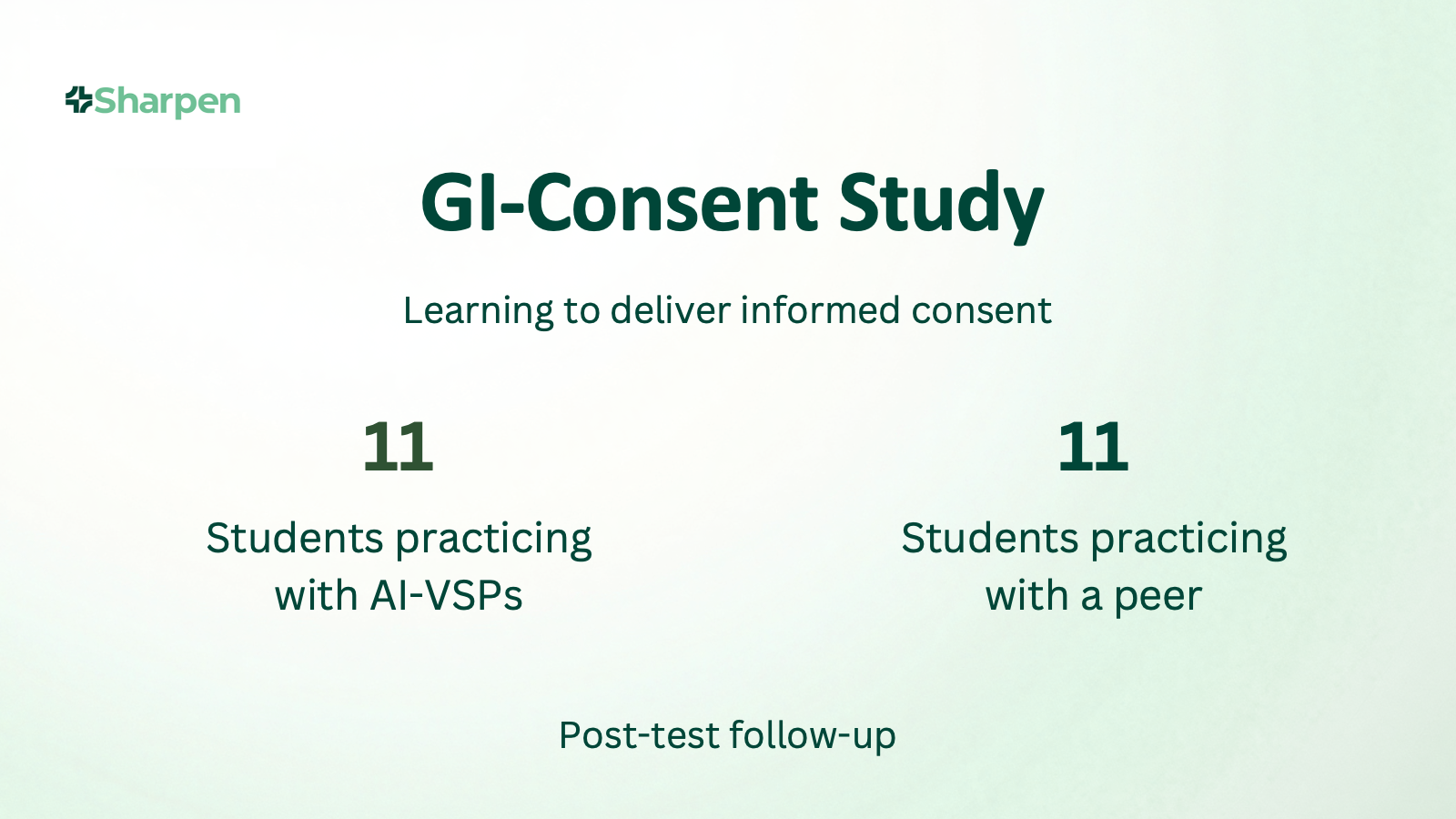
Can practice with an AI virtual patient help students learn to deliver informed consent? GI-Consent compared AI practice with peer role play.
Grand Demo Day 2026 · Slide 21 · Select image to view full size
Eleven students practised with AI virtual patients and eleven with peers. The presentation reported no statistically significant differences between groups in consent performance (p = 0.27), communication (p > 0.05) or confidence (p = 0.80). These results describe a small comparison and do not establish equivalence.
Grand Demo Day 2026, slides 20–22
Assessment tool and validation study
VSP-QAT: assessing the quality of virtual patients
Shania Tubana-Dean and Yousif Yousef
Tool built; pilot study planned
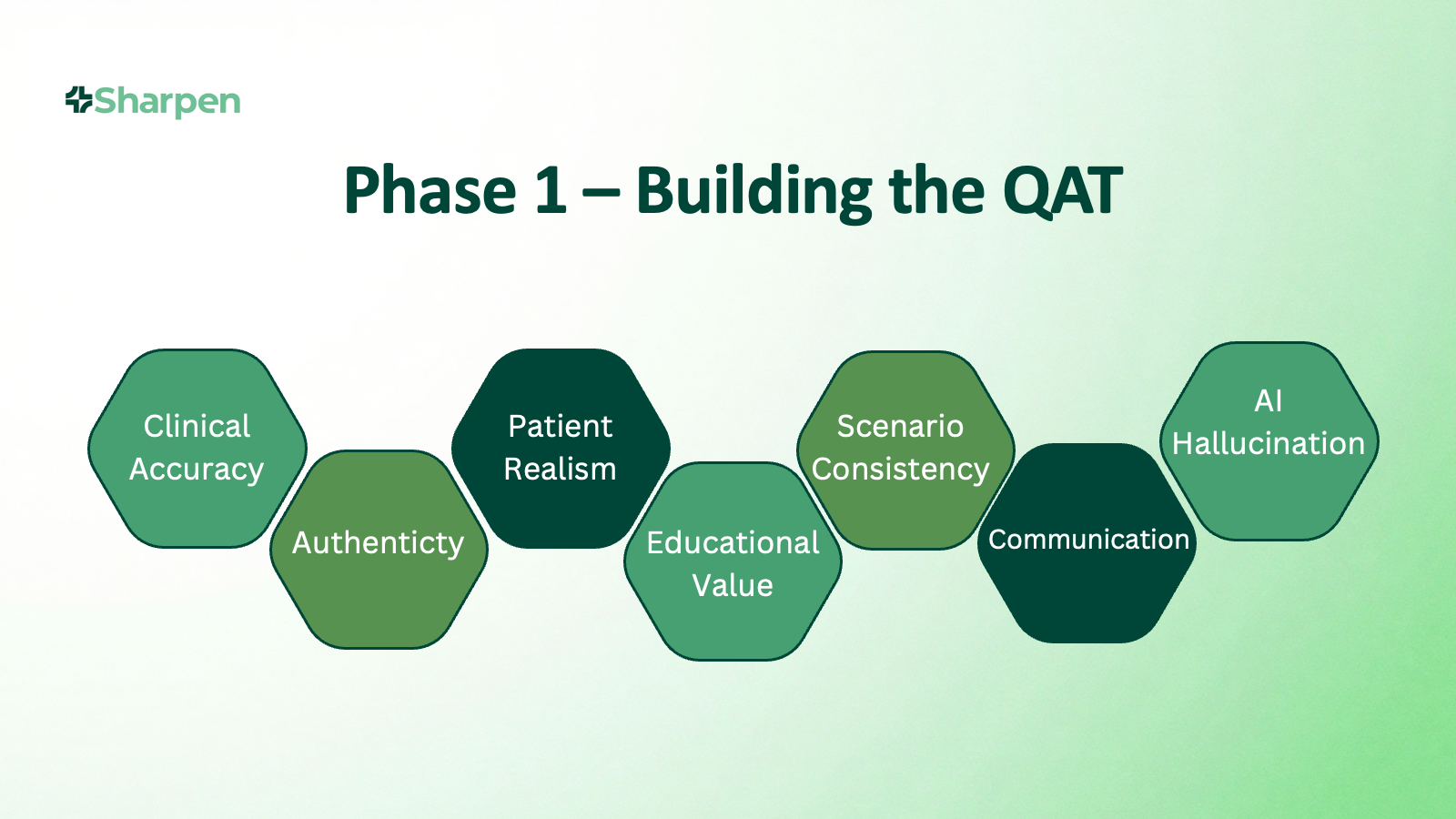
A virtual patient needs to do more than hold a conversation. VSP-QAT evaluates clinical accuracy, realism, communication, consistency and educational value.
Grand Demo Day 2026 · Slide 25 · Select image to view full size
The team built a quality-assessment tool and outlined a blinded evaluation of recordings from deliberately high- and low-quality virtual patients. The proposed design includes 12 student volunteers, four recordings and ten blinded reviewers. The next step described in the deck is a pilot study.
Grand Demo Day 2026, slides 23–31
Software prototype
Tipoca: Action Quality Assessment
Emily Chan, James Sheng and Abdul Adill Mohammed
Functional prototype in testing and optimization
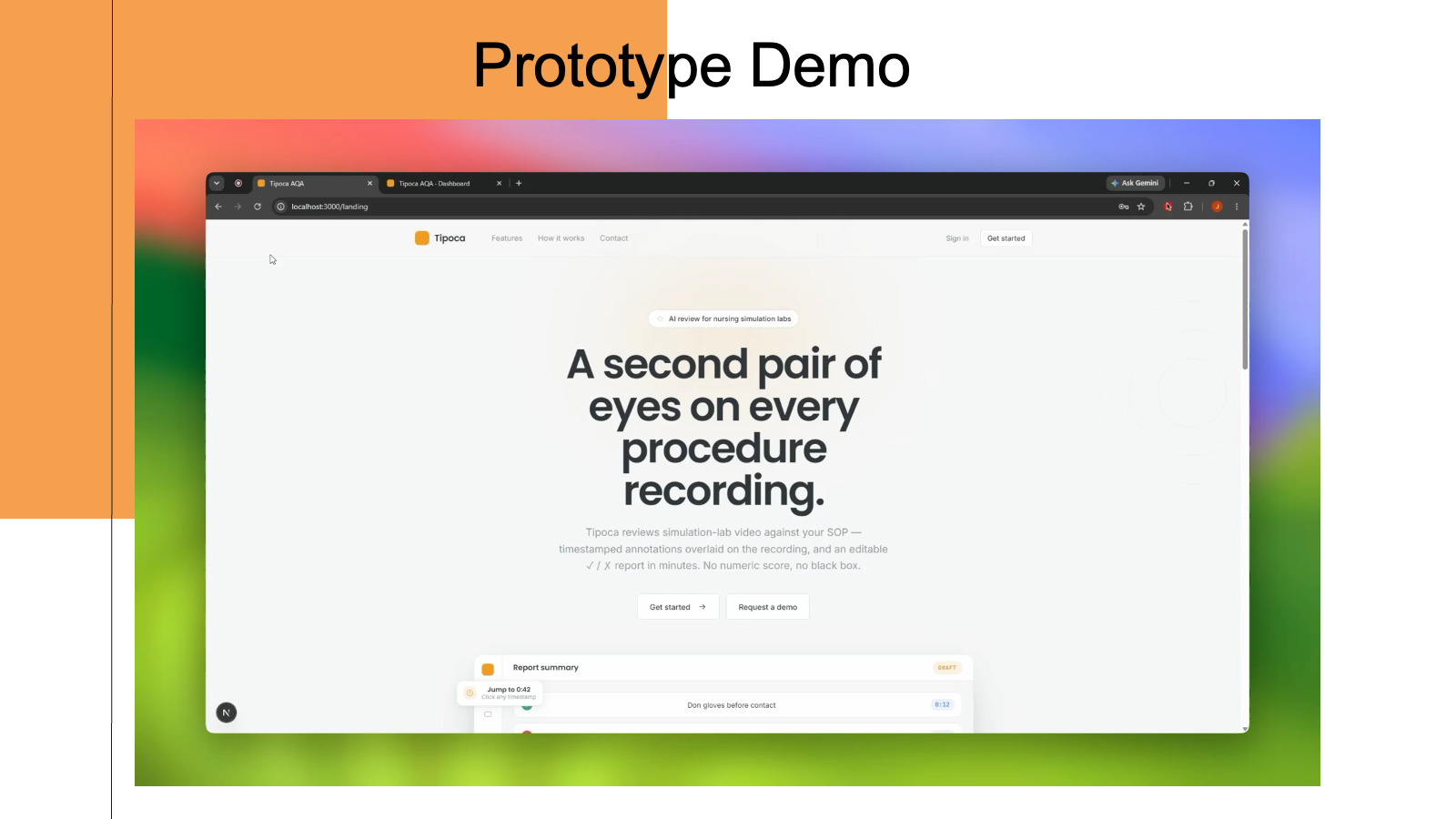
Tipoca reviews a recording of a clinical procedure against a standard operating procedure. It uses a vision-language model to assess individual steps and helps instructors review a student’s performance.
Grand Demo Day 2026 · Slide 40 · Select image to view full size
The team presented a working prototype with timestamped annotations and an editable report. Their development work included the evaluation pipeline, application architecture and interface. Testing highlighted variability in model responses. The stated next steps were a maintenance and deployment pipeline and production deployment.
Grand Demo Day 2026, slides 33–45
AI benchmark and evaluation
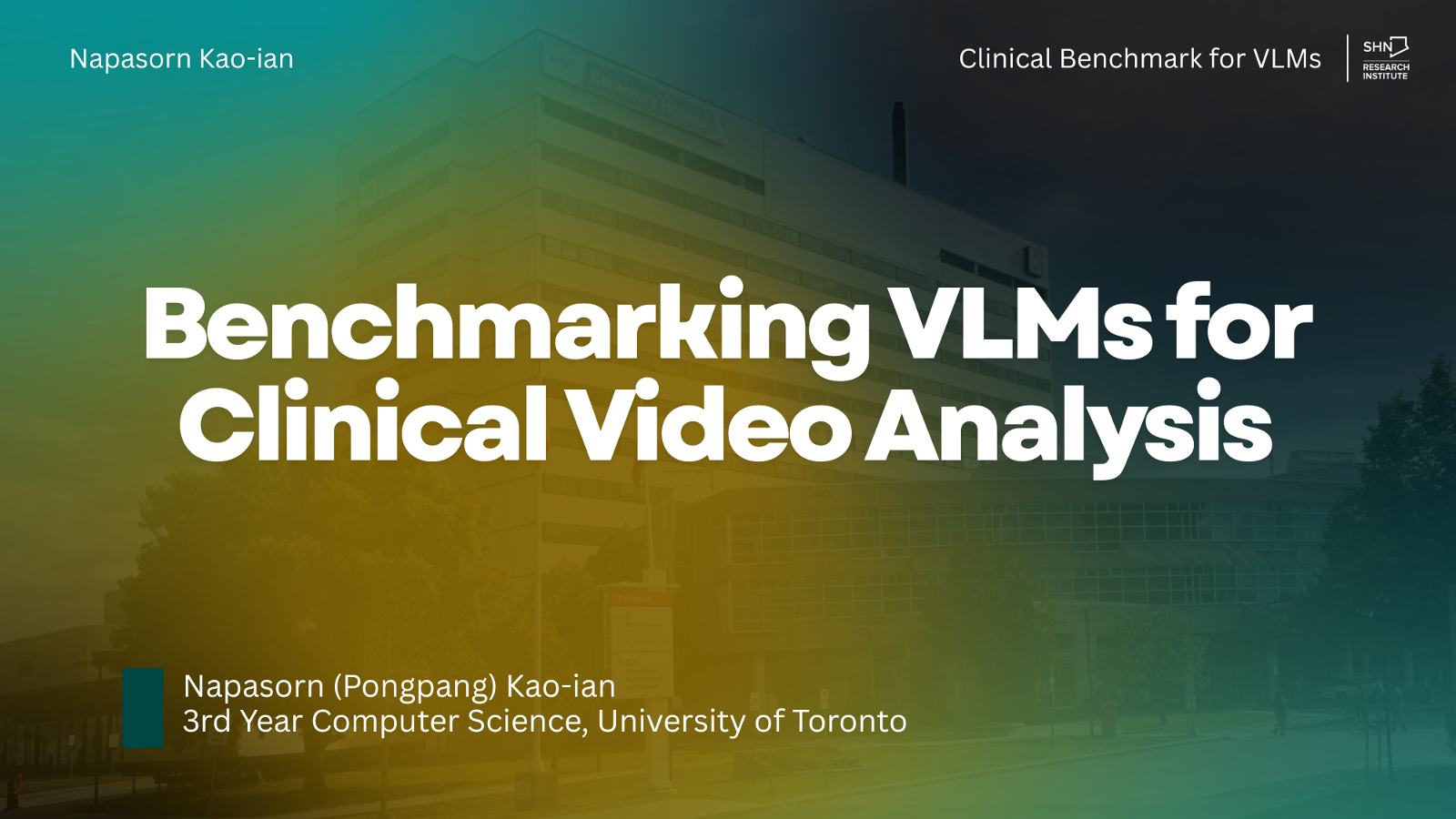
Benchmarking vision-language models for clinical video analysis
Napasorn (Pongpang) Kao-ian
Benchmark methods and model results presented
This project tests whether vision-language models can understand clinical procedures and assess performance from video, beyond recognizing a static medical image.
Grand Demo Day 2026 · Slide 48 · Select image to view full size
The presentation uses NurViD videos to evaluate procedure, action-step and joint classification, and AIxSuture videos to assess suturing proficiency and rubric scores. Results show different performance across models and tasks, with examples of commonly confused procedures and actions. The work examines what these models can reliably contribute to clinical education.
Grand Demo Day 2026, slides 46–58
Clinical education hardware and software
Sharpen Box: Performance Assessment System
Summer of Vibes software team
Recording and feedback workflow demonstrated
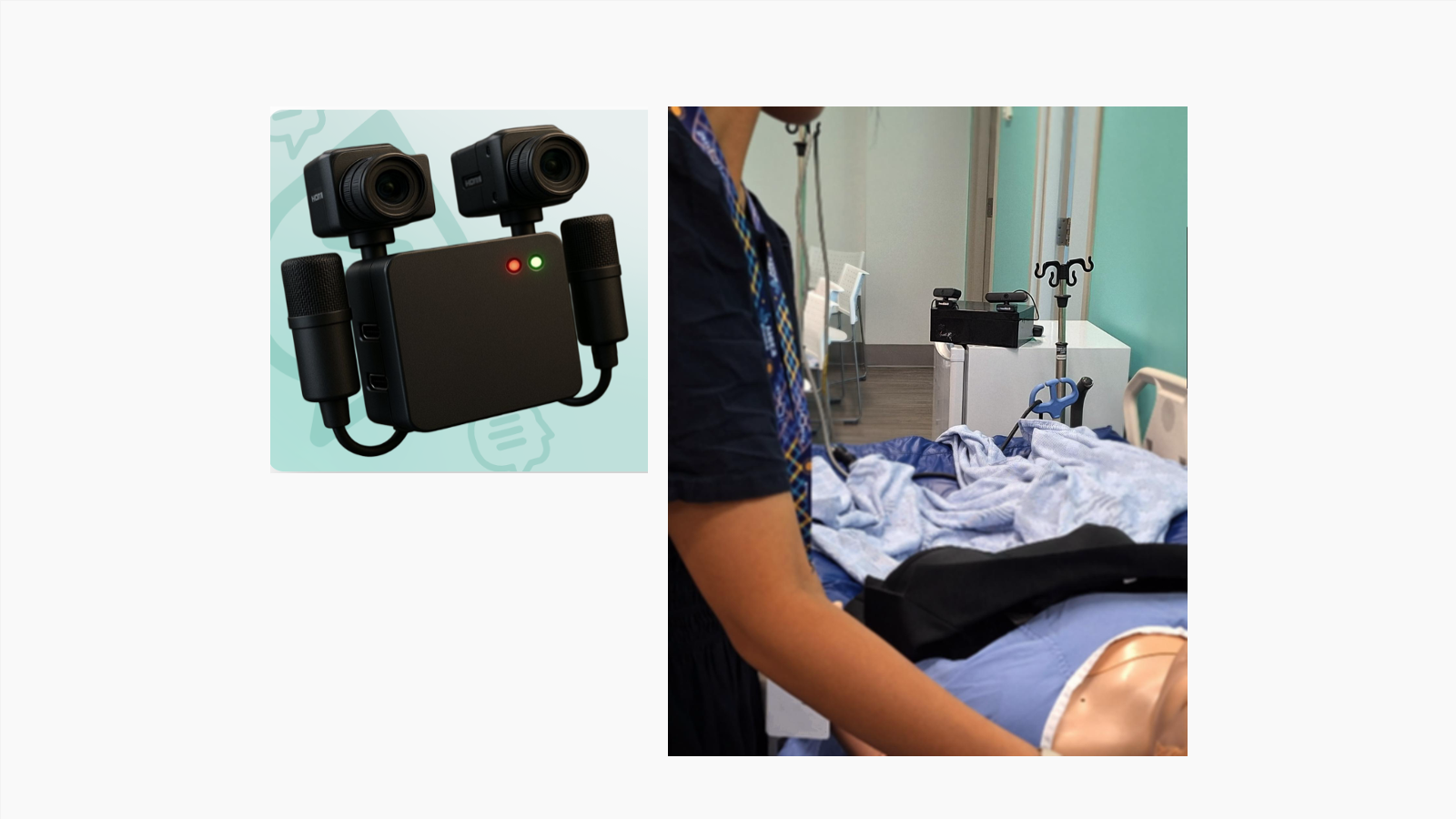
Sharpen Box records a clinical encounter for an AI-supported review. Instructors can review suggested feedback and approve the points a student should work on next.
Grand Demo Day 2026 · Slide 62 · Select image to view full size
The demonstration connects a recording device, a video-transfer application and a performance-review interface. Its aims are timely personalized feedback, a way to follow improvement over time and less administrative work for instructors. A separate PAS validation study examines assessment accuracy and the experience of learners and institutions.
Grand Demo Day 2026, slides 59–66
Educational assessment research
Validating the Performance Assessment System
Angelica Roxas and Jana Kalbasi
Validation study design presented
The PAS study asks whether an AI assessor can match a human examiner and support continuing formative assessment in medical education.
Grand Demo Day 2026 · Slide 68 · Select image to view full size
The presentation sets out objectives to validate accuracy, measure learner growth and assess institutional value. It names clinical-performance and communication measures alongside technology-acceptance instruments, and outlines a comparison design. Integration within SHARPEN and a wider assessment network are described as future directions.
Grand Demo Day 2026, slides 68–75
Cross-Canada survey
EMBER: medical-applicant burnout and resilience
Zaina Chowdhury and Jake Segall
Survey design and recruitment plan presented
EMBER examines burnout among Canadian medical-school applicants and asks how psychological resilience may influence their experience of the application process.
Grand Demo Day 2026 · Slide 78 · Select image to view full size
The survey covers demographics, academics, extracurricular activities and resilience. The recruitment plan includes pre-medicine societies, university groups and social media. The presentation describes survey development, recruitment and planned analysis, rather than completed national findings.
Grand Demo Day 2026, slides 78–96
Cross-sectional survey study
Why Learn: student perceptions of artificial intelligence
Jessica Segall
Survey design and expected outcomes presented
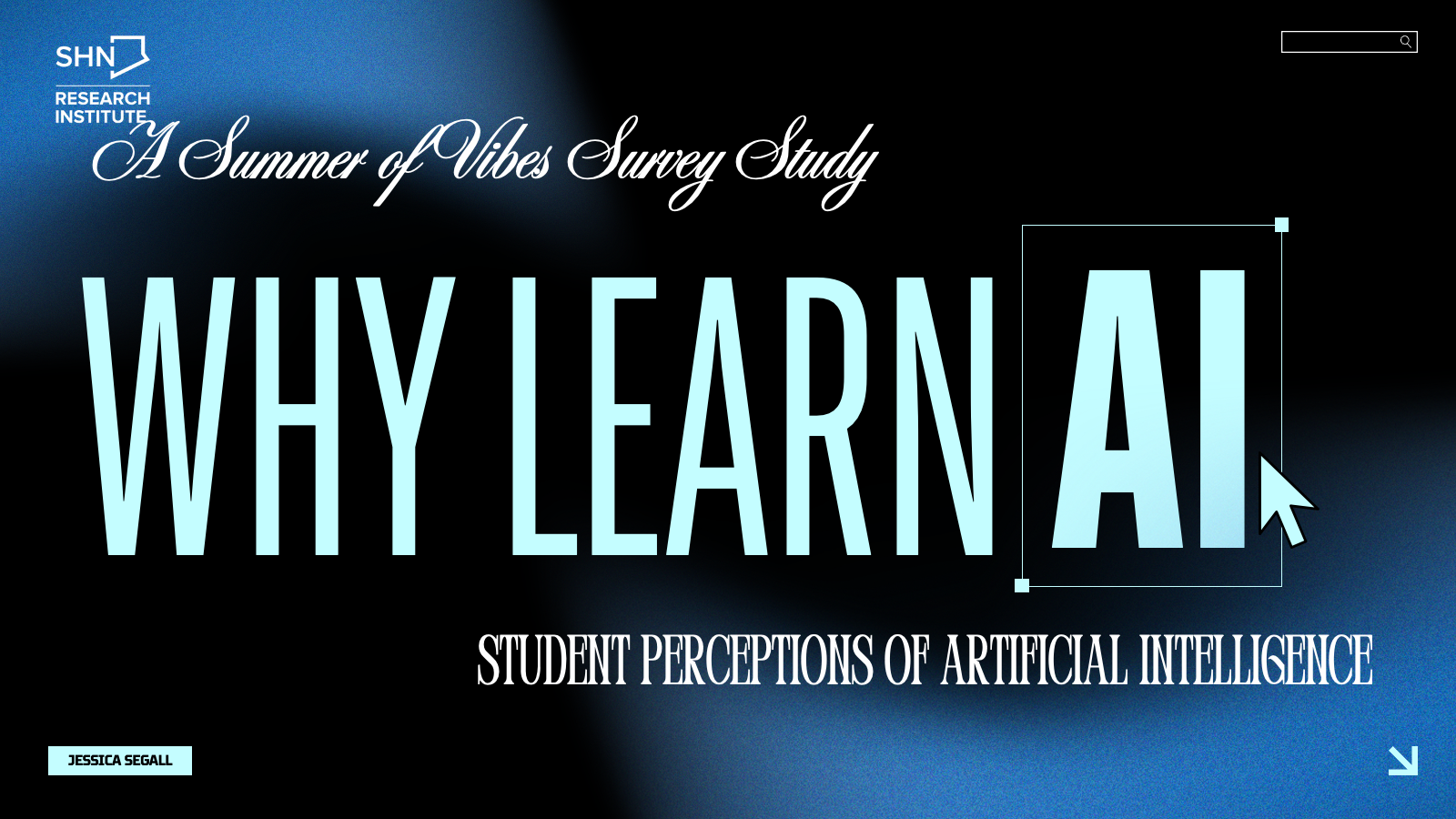
Why Learn asks how AI literacy relates to students’ readiness to use AI in healthcare and innovation.
Grand Demo Day 2026 · Slide 97 · Select image to view full size
The study targets 200–300 learners and students. Survey topics include AI knowledge, perceptions of healthcare uses, ethical concerns, education, career motivation and AI-assisted workflows. Its expected association between self-perceived knowledge and readiness is a hypothesis; the deck does not present completed survey findings.
Grand Demo Day 2026, slides 97–105
Systematic review and meta-analysis
AI detection and independent performance in endoscopy trainees
Summer of Vibes research team
Review methods presented
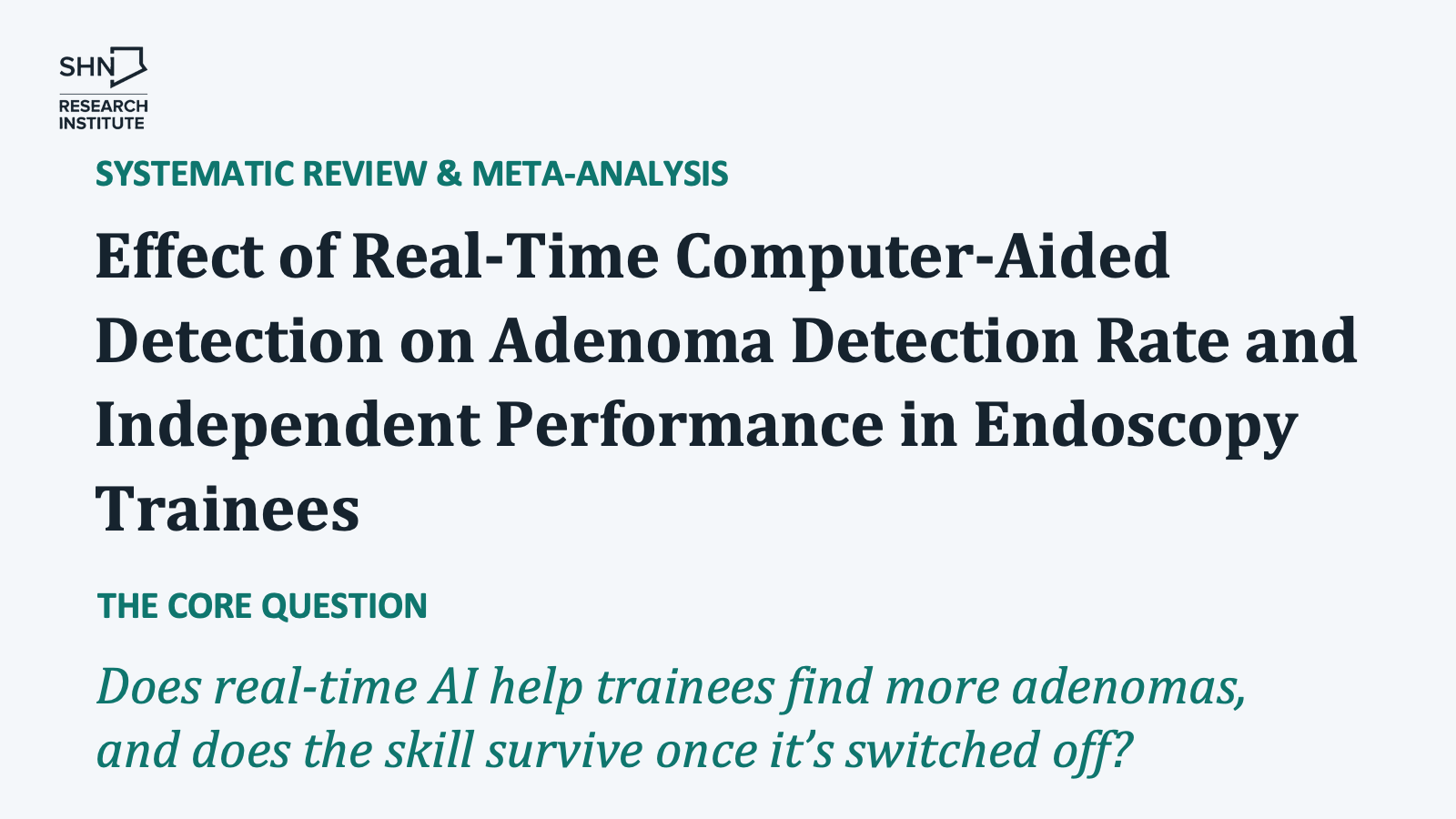
The review asks whether real-time computer-aided detection improves trainees’ adenoma detection, and whether any benefit persists once AI assistance is removed.
Grand Demo Day 2026 · Slide 110 · Select image to view full size
The planned search spans ten sources from 2017 onward. Two reviewers screen the literature and extract trainee characteristics, AI systems, detection outcomes and performance without AI. The intended analysis separates assisted performance from learning transfer. No pooled result was presented in these slides.
Grand Demo Day 2026, slides 106–117
Randomized trial design
What happens when the AI is taken away?
Keshav Sharma
Trial protocol presented
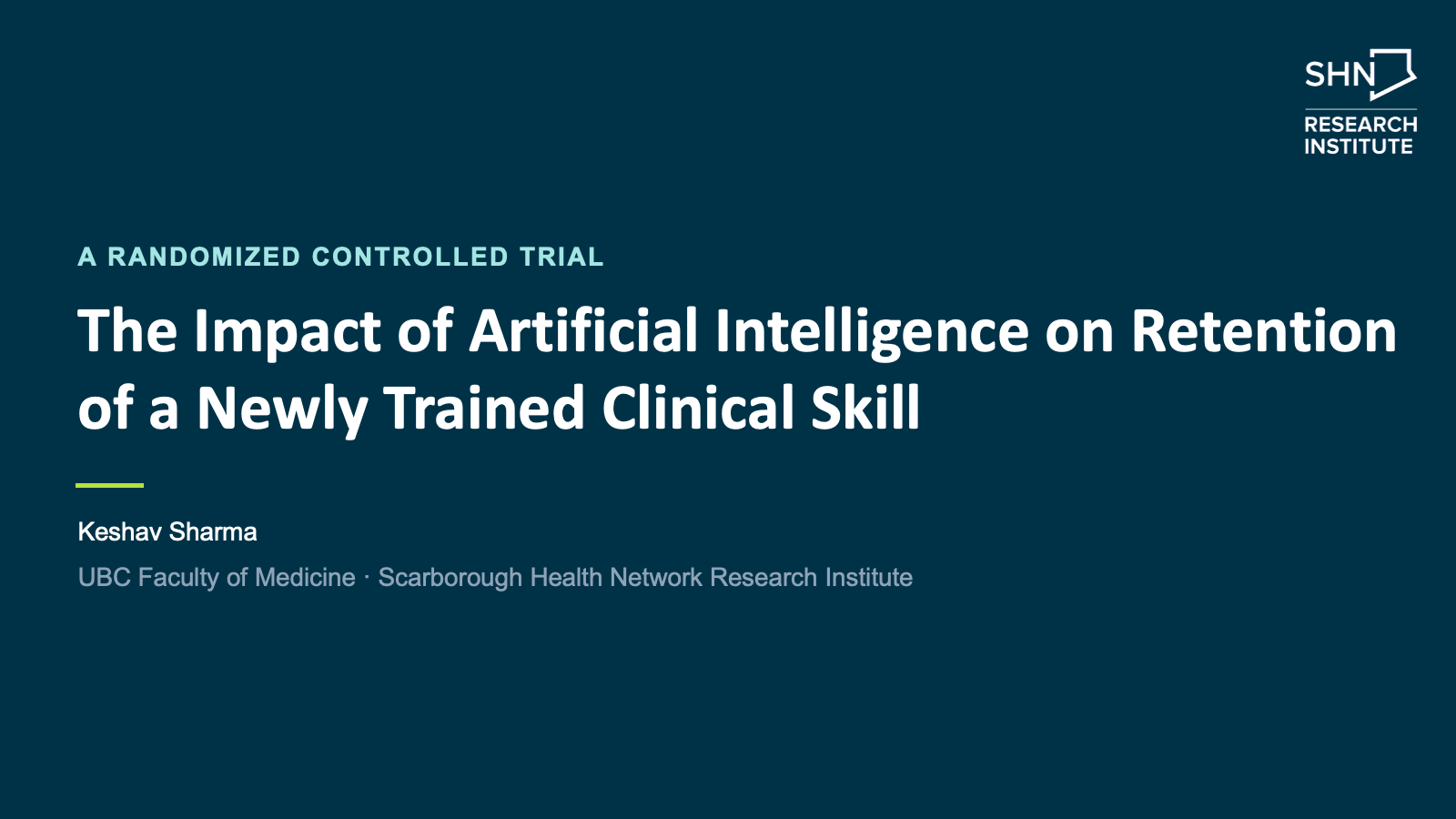
This study asks whether AI assistance changes a learner’s ability to retain a newly learned clinical skill. It uses arterial blood gas interpretation as the task.
Grand Demo Day 2026 · Slide 121 · Select image to view full size
Novices first complete standardized training and reach a minimum performance standard. The proposed trial then assigns them to no AI, unrestricted AI or Socratic AI that guides their reasoning without giving diagnostic answers. The primary endpoint is performance 24 hours later with AI removed. Cognitive load, reasoning quality, confidence and AI trust are secondary outcomes.
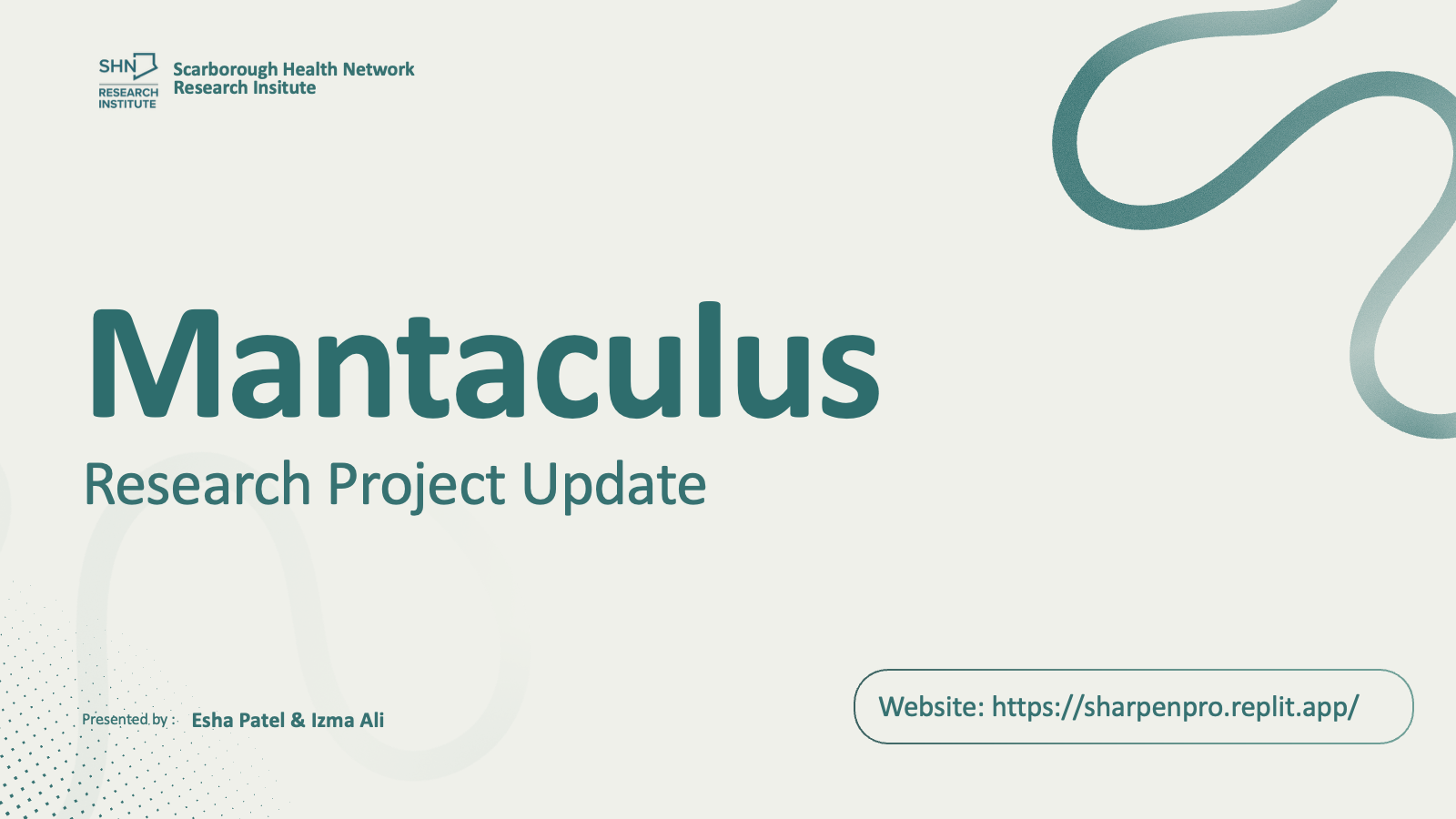
Mantaculus asks learners to answer a question, rate their confidence and explain their reasoning. Adaptive feedback and follow-up questions respond to gaps in understanding.
Grand Demo Day 2026 · Slide 132 · Select image to view full size
The proposed randomized study compares Mantaculus with traditional learning among adult pre-medicine undergraduates. It includes a pre-test, a post-test and a delayed post-test to assess knowledge retention. The research also asks whether learners become more accurate in judging what they know. The presentation did not report trial outcomes.
Grand Demo Day 2026, slides 131–142
Health-services research
Evaluating Interprofessional Primary Care Teams
Laura Gates and Madeleine Isaac-Gooden; principal investigator Dr. Kevin Kuo
Preliminary program figures and an evaluation plan presented
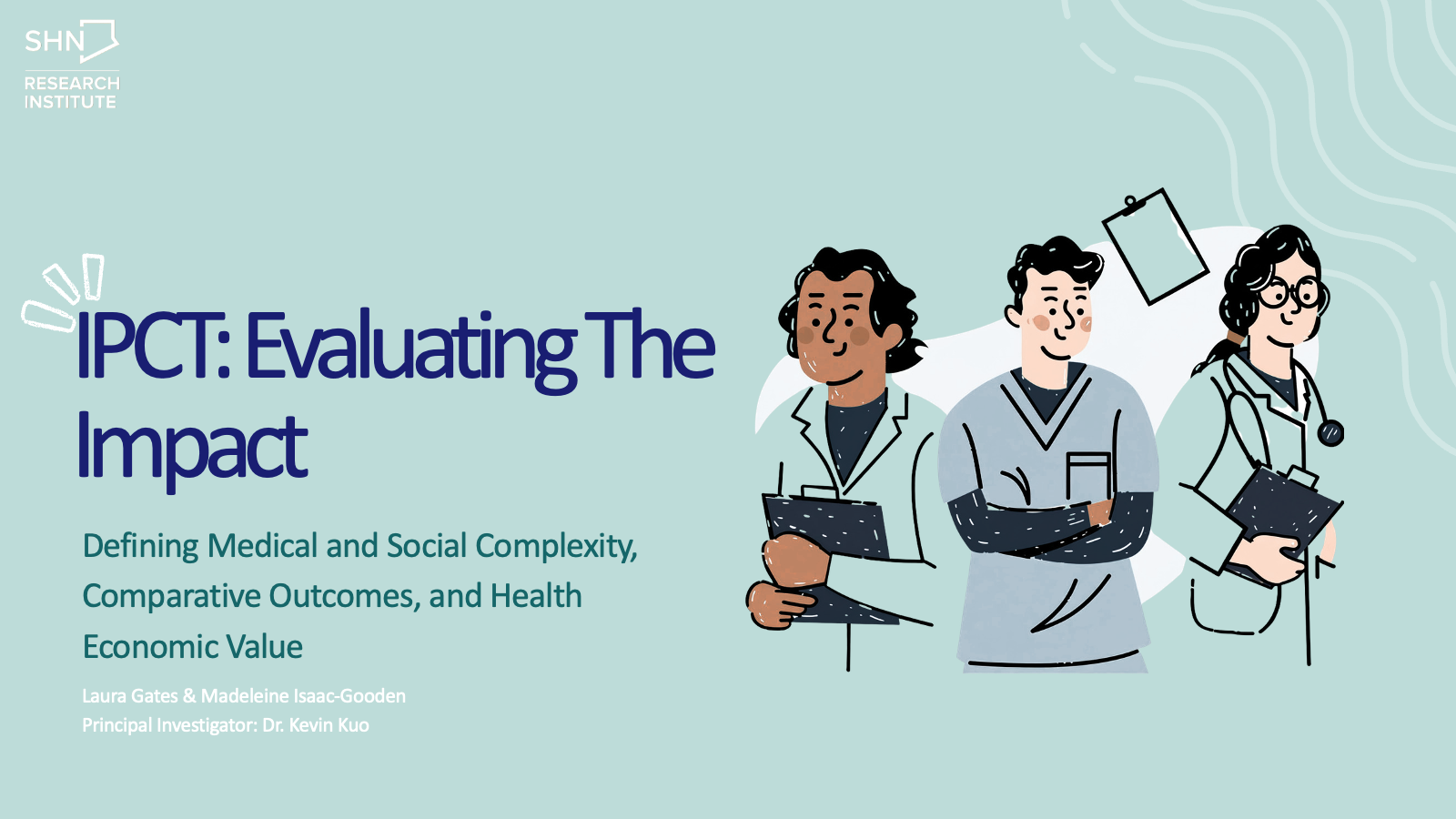
The IPCT project examines primary-care attachment for patients with medical and social complexity. It asks who should receive referrals, whether attachment changes subsequent healthcare use and whether the model delivers long-term economic value.
Grand Demo Day 2026 · Slide 148 · Select image to view full size
The team outlined a data-based definition of complexity, a 1:3 matched-cohort comparison and a health-economic model. Outcomes include emergency-department revisits, inpatient admissions and mortality. Preliminary service figures in the deck provide context for the proposed evaluation; they are not a completed causal estimate of the program’s effect.
Grand Demo Day 2026, slides 145–162
Geospatial research and predictive modelling
GEO-EoE: mapping a gap in Canadian disease data
Zaina Chowdhury, Richard Xie and Yusuf Siddiqui
Data collection and tool-development plan presented
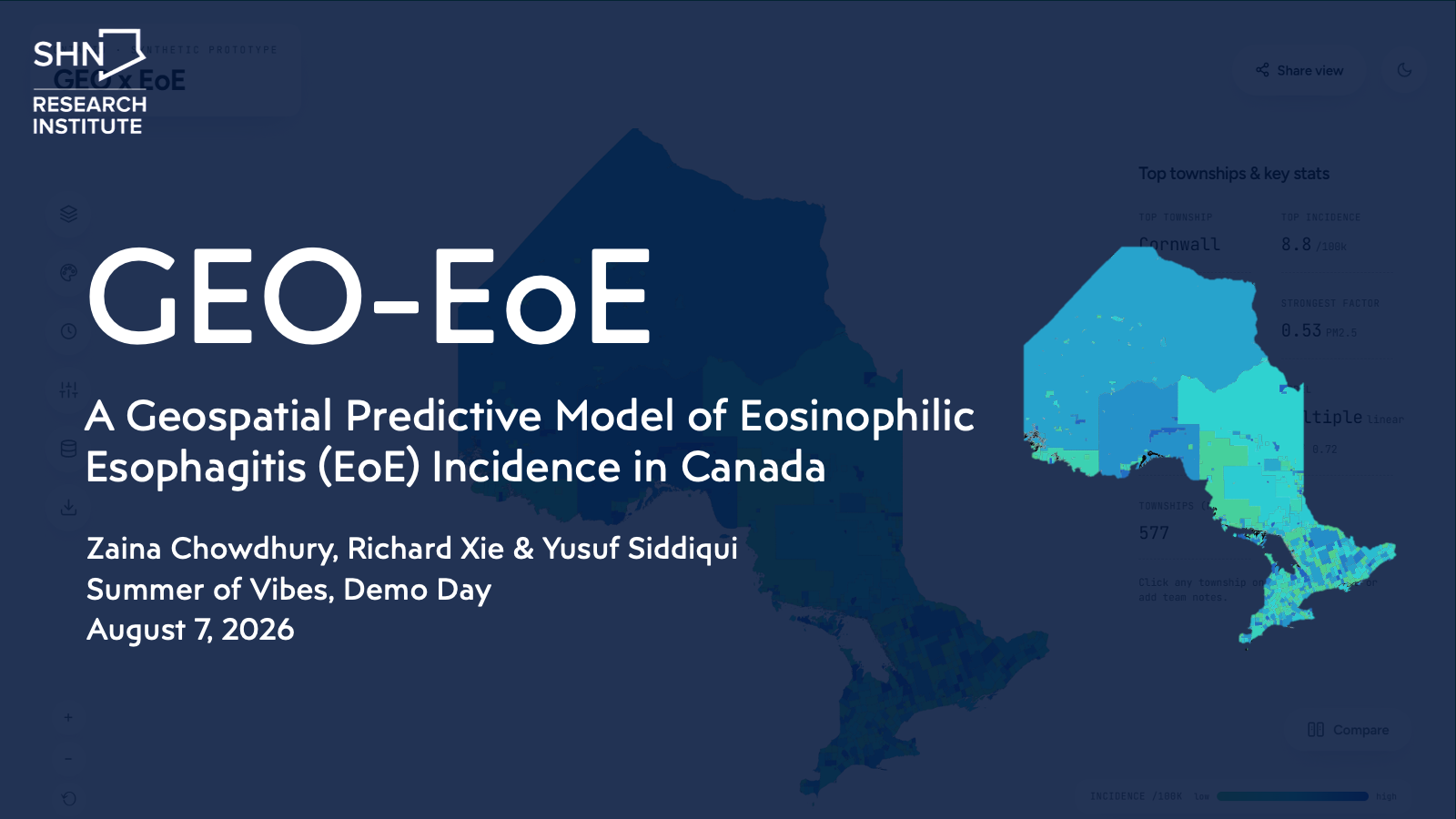
GEO-EoE proposes a map of regional eosinophilic esophagitis incidence in Canada, with a model to estimate incidence in places where data are missing.
Grand Demo Day 2026 · Slide 163 · Select image to view full size
The work investigates possible associations with environmental and geographic factors, including air and water quality, allergens and proximity to gastrointestinal clinics. The presentation outlines data collection, tool development, a retrospective risk-factor study and predictive modelling. These are research aims, not established associations.
Grand Demo Day 2026, slides 163–176
AI evaluation research
Checking HealthBench against clinical guidelines
Izma Ali, Esha Patel and Yusuf Siddiqui
Research approach presented
This project asks whether HealthBench reference answers agree with clinical practice guidelines. It focuses on gastroenterology and hepatology.
Grand Demo Day 2026 · Slide 178 · Select image to view full size
The team’s approach is to assemble a guideline corpus, identify relevant HealthBench conversations, match them to recommendations and score concordance. Proposed future work includes a new benchmark and expansion to other specialties. The presentation does not report a completed concordance analysis.
Grand Demo Day 2026, slides 177–195
Clinical research platform
ContextCare: clearer discharge information
Summer of Vibes ContextCare team
Platform demonstration and feasibility-study aim presented
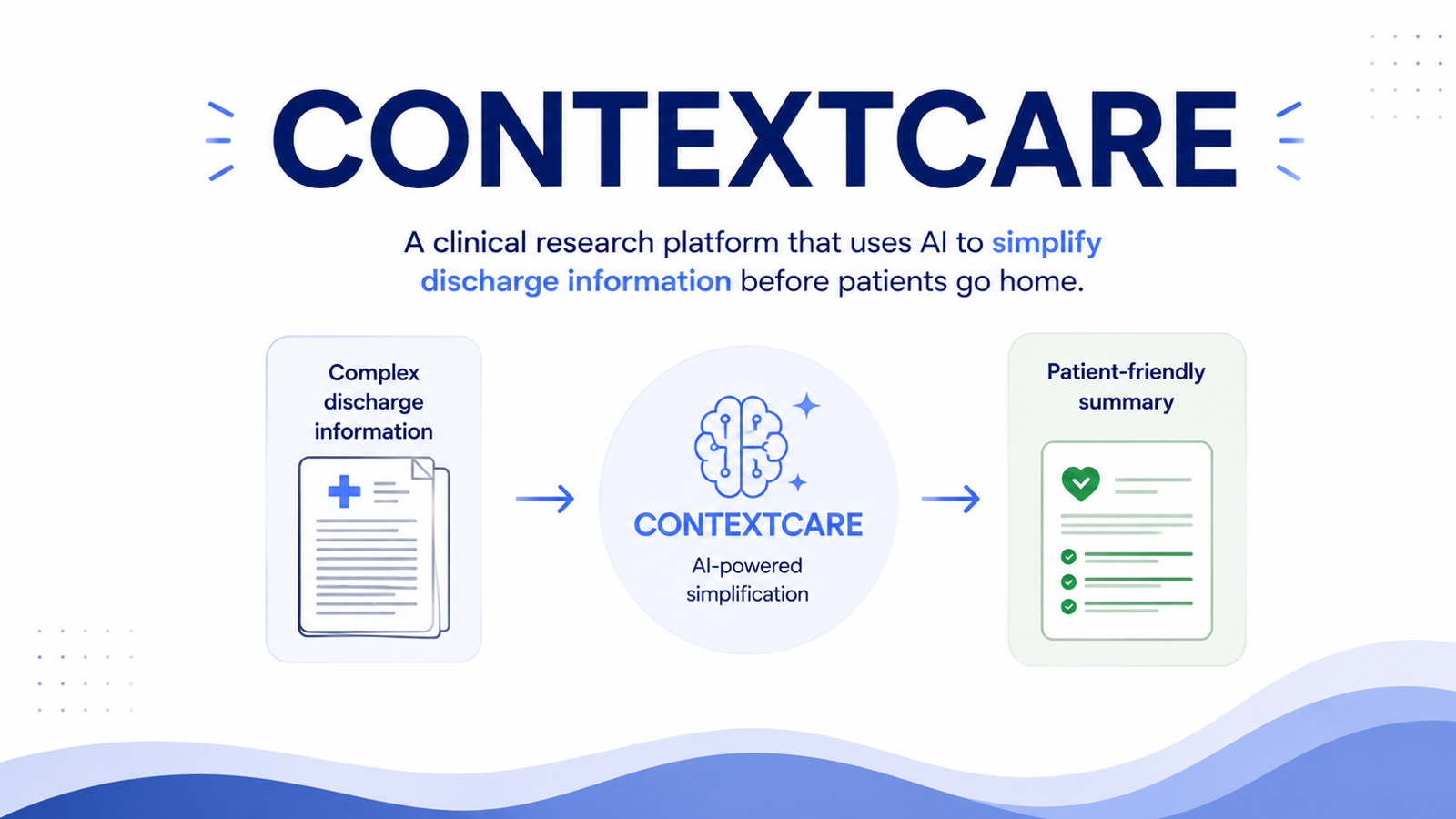
ContextCare uses AI to turn complex discharge information into a patient-friendly summary before a person leaves hospital. The project pairs the software with a study of discharge communication.
Grand Demo Day 2026 · Slide 204 · Select image to view full size
The demonstrated workflow includes health-literacy assessment, simplified summaries and a teach-back assessment. Additional features shown include multiple languages, audio summaries and a review of identifying information before simplification. The proposed study evaluates feasibility and patients’ comprehension and retention; at-home access and clinical integration are future directions.